


This link leads to a fine account of business in Liberia and why business development is so critical to stabilizing the nation. It is also a very moving statement about industriousness, conscientousness and family loyalty and responsibility in Liberia.
http://karenbulthuis.blogspot.com/


RIGHT9
Wednesday, July 29, 2009

Sunday, June 21, 2009
4-H in Liberia
One piece of advice we received before we left was to take pictures of home and family with us to Liberia to show our hosts. We dutifully made up albums of our children and families and one of my photos featured a 4-H barn with the 4-H clover symbol painted on the side (it is the centerpiece building of the Southwestern 4-H Center where Win - Emmalee's brother - works). When Mrs. Rosa Allen saw that picture her eyes lit up and she exclaimed "Oh, 4-H!". Then she burst into song. As it turned out, 4-H played a big part in her childhood and she has very fond memories of it. She even remembered the 4-H song she learned in 6th grade.
We spent some time sharing 4-H stories - Rosa raised rabbits, planted gardens and developed a rice field, she said. It was clear from her enthusiasm that Rosa had wonderful memories of 4-H and it played a very large and positive part in her childhood. She asked if it would be possible to bring 4-H to Lott Carey School and establish a 4-H Club there for the students.
It occurred to us that Rosa singing the 4-H song should be captured on film. Several days later, after she overcame some reluctance and rehearsed a bit, she allowed us to record her rendition of the childhood song and submitted to a brief interview.
This lady really loves 4-H!
Mrs. Allen is a very fine school administrator. She coordinated the teacher training workshop and supervised the library children's section renovation when the LOEP team was there. This video was done in the book storage room as we unpacked boxes of donated books and worked on the library project.
Tuesday, June 2, 2009
If it can be done with polio, why not malaria

The World Health Organization announced the other day that it is launching a polio vaccination campaign in selected counties in Liberia. The Liberian counties where children will be vaccinated are adjacent to the border of Guinea where there has been an outbreak of polio. The initiative in Liberia is a preventative measure to keep Liberia polio-free - there have been no cases there since 2006, according to WHO officials.
If vaccinations can keep Liberia polio-free just think what those sleeping nets could do against malaria if every child had them.
Thursday, May 28, 2009
Cause for Creation
Supporting educational efforts for orphans and vulnerable children in Liberia requires a network of partners and a whole lot of dedicated, committed folks. One of LOEP's partners is Cause for Creation, a business of artist Char Turner whose original artwork is 100 percent dedicated to children in Liberia. Char's art work has made an enormous difference in the lives of children in Liberia. Sales of her original prints and handmade cards have funded bunk beds for children at AAMOM, a library at CRM, teacher training at Lott Carey Mission School and countless other projects that have directly benefitted the health and welfare of orphans in Liberia. Check out her web site. Turner original prints make a stunning impact matted and framed on the wall. Cause for Creation greeting cards are a beautiful statement of compassion for the receiver and make a difference in the lives of children.
Link to Cause for Creation: http://causeforcreation.wordpress.com/
Link to Cause for Creation: http://causeforcreation.wordpress.com/
Wednesday, May 27, 2009
Getting ready
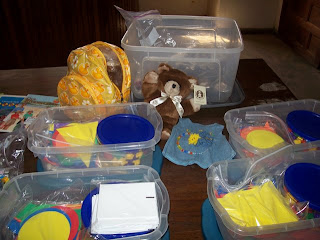
 The picture shows Rev. Sam-Peal unpacking the Classroom-in-a-Box units used for the LOEP teacher Training in February, 2009. The Classroom-in-a-Box units were packed in Summer, 2008, shipped in October 2008, and unpacked in February, 2009 when we arrived in Liberia for training.
The Classroom-in-a-Box units each contain subject-specific materials - one is math/science and the other language arts/social studies, for example. This particular pair of units also shared a "Teddy Bears" theme based on the generous donation of 30plus teddy bears from a Fredericksburg merchant and donation of hand made costumes for each bear from a LOEP supporter. The Language arts/social studies unit included story books and instructional materials with bears and woodland themes. The math/science unit included "counting bears" color/counting games (top picture) and environmental lessons on preserving bear and other animal habitat. Part of the learning process for young children is creative play and teddy bears with fancy, fun costumes certainly filled a good part of that requirement.
LOEP training is based on subject matter and focused on how students learn so each classroom-in-a-box unit is filled with instructional materials and companion lesson plans that are coordinated with the concepts and principles in the LOEP Teacher Training. This means that our training program, training materials and the classroom-in-a-box units have to be ready months in advance for shipment so all will be there and ready when we arrive in Liberia for the training.
Developing a single LOEP Teacher training requires a full 12 month timeline
We have been preparing since April for the next training trip in January, 2010, putting together the first shipment of instructional materials. School supply donations are coming in and every evening we are sorting and packing for the first May shipment - we will deliver it to the shipper this week-end for shipment next week from Baltimore, MD. A second September-October, 2009 shipment of training handbooks, training guides and instructional materials for hands-on teaching and demonstrating will follow this Fall.
The January, 2010 training is geared to teachers in upper Elementary, Middle and High School grades so the themes and materials are very different from cute little costumed bears.
All the same, packing on this side and opening boxes on the other side is like Christmas!
Tuesday, May 19, 2009
Future docs and nurses need Science
 Liberia's future health care professionals? How will they learn the science necessary to succeed?
 This is the Lott Carey Mission School science laboratory. It was a functioning school lab classroom before the war but has been essentially useless as a lab for years now. Re-construction and repair has stalled due to lack of funds and physical plant limitations. Teaching science with experiments, scientific inquiry, hands-on learning - difficult and limited without basic science equipment. Students are taught science from the blackboard, copying notes and memorizing.
The sign on the door of the Biology Classroom refers to the room's past use when there was equipment and text books to support science study. Clearly there is not much opportunity for biology experiments now.
The above pictures illustrate a major problem for Liberia in particular and Africa in general:
How can serious students of science - future doctors, nurses, dentists, therapists and other health care professionals - be produced by schools with such limitations for hands-on learning in science?
Teaching science through observation, using available materials such as plants, animals, weather and stars, study of the human body with illustrated texts can produce well-rounded students with adequate general knowledge of science but not enough science to become a doctor or a researcher in the scientific world of today. Students with an inadequate science foundation cannot withstand competitive admission policies at universities and, for the few who do enter academic science programs, their prospects for finishing are not good. They start out too far behind to catch up to other students from strong secondary school science programs.
Lott Carey Mission School Superintendent Rev. Emile Sam-Peal agrees with other experts who are concerned that development in Africa will continue to lag if medical care does not improve.
Children who are taught in inadequate science education facilities are simply not inspired and able to study the type of science that produces doctors and nurses.
Before war broke out in 1989, there were 250 licensed doctors practicing in Liberia. Now medical care for Liberia's three and a half million people consists of;
· 50 Liberian doctors, according to UN estimates. There are also about 75-100 doctors serving with missions, NGOs and other aid groups.
· Three hospitals in Monrovia - one of those was converted from a war-ruined school into a small hospital with 150 beds and one operating room. The largest is a war-ruined medical facility of 1970s vintage with intermittent electricity, among other severe limitations.
· NGOs that operate more than 70 percent of health care facilities in Liberia
· 50 Liberian doctors, according to UN estimates. There are also about 75-100 doctors serving with missions, NGOs and other aid groups.
· Three hospitals in Monrovia - one of those was converted from a war-ruined school into a small hospital with 150 beds and one operating room. The largest is a war-ruined medical facility of 1970s vintage with intermittent electricity, among other severe limitations.
· NGOs that operate more than 70 percent of health care facilities in Liberia
There is a major push to shore up Liberia's health care system and the Ministry of Health is highly respected in a nation where the public's trust in government bureaucracy is generally low. But where are the doctors and nurses going to come from? Science studies in Liberia's schools are out-of-date and facilities woefully inadequate.
Living and Dying in Liberia
One of the questions we are frequently asked about our time in Liberia is: "Is it safe there"? Generally the question refers to personal safety from violence, threats of left-over war unrest, etc. The answer for us is an emphatic, yes, we felt very safe personally and never felt personally threatened or even uneasy – we only felt welcomed. Liberians are exceedingly friendly, appreciative and hospitable. Our host was protective and solicitous and our job to train teachers meant we spent most of our time at school with quiet evenings at home working on the next day's training program. (Our host was protective but that didn’t keep him from working us hard - it was great!)
Personal safety and protection from violence is not the only measure of safety, though, and we were very aware of personal, individual vulnerability in a nation where there are no emergency services and access to health care is minimal. There are no rescue services with ambulances, fire trucks, etc. in Liberia. The only ambulances we saw with sirens and lights going during our time there were provided by NGOs such as Doctors without Borders and UNMIL (United Nations Mission in Liberia). It was not clear how the patient in those vehicles qualified for help and a race to the hospital but certainly such access is extremely limited – only available to the average person by chance or some luck of the draw.
Traffic and driving is chaotic and wrecks often result in horrible death and injury with only passersby to administer first aid or assistance. We happened upon one auto wreck and, before I turned away with a lurching feeling in my chest, I saw a motorcycle under the front wheels of a Hummer-type NGO vehicle. The motorcycle tried to take a turn, passing close on the inside and ended under the wheels of the much larger, heavier vehicle. A crowd had already gathered and people were trying to be helpful and provide what assistance they could. There was much shouting, gesturing and it seemed an effort to pull something/one from under the vehicle was underway. Here in the U.S. such a crowd would likely be waiting quietly for trained medical personnel in the ambulance speeding to the rescue. In Liberia there is no rescue – they know they are on their own.
Personal safety and protection from violence is not the only measure of safety, though, and we were very aware of personal, individual vulnerability in a nation where there are no emergency services and access to health care is minimal. There are no rescue services with ambulances, fire trucks, etc. in Liberia. The only ambulances we saw with sirens and lights going during our time there were provided by NGOs such as Doctors without Borders and UNMIL (United Nations Mission in Liberia). It was not clear how the patient in those vehicles qualified for help and a race to the hospital but certainly such access is extremely limited – only available to the average person by chance or some luck of the draw.
Traffic and driving is chaotic and wrecks often result in horrible death and injury with only passersby to administer first aid or assistance. We happened upon one auto wreck and, before I turned away with a lurching feeling in my chest, I saw a motorcycle under the front wheels of a Hummer-type NGO vehicle. The motorcycle tried to take a turn, passing close on the inside and ended under the wheels of the much larger, heavier vehicle. A crowd had already gathered and people were trying to be helpful and provide what assistance they could. There was much shouting, gesturing and it seemed an effort to pull something/one from under the vehicle was underway. Here in the U.S. such a crowd would likely be waiting quietly for trained medical personnel in the ambulance speeding to the rescue. In Liberia there is no rescue – they know they are on their own.
Subscribe to:
Posts (Atom)
